


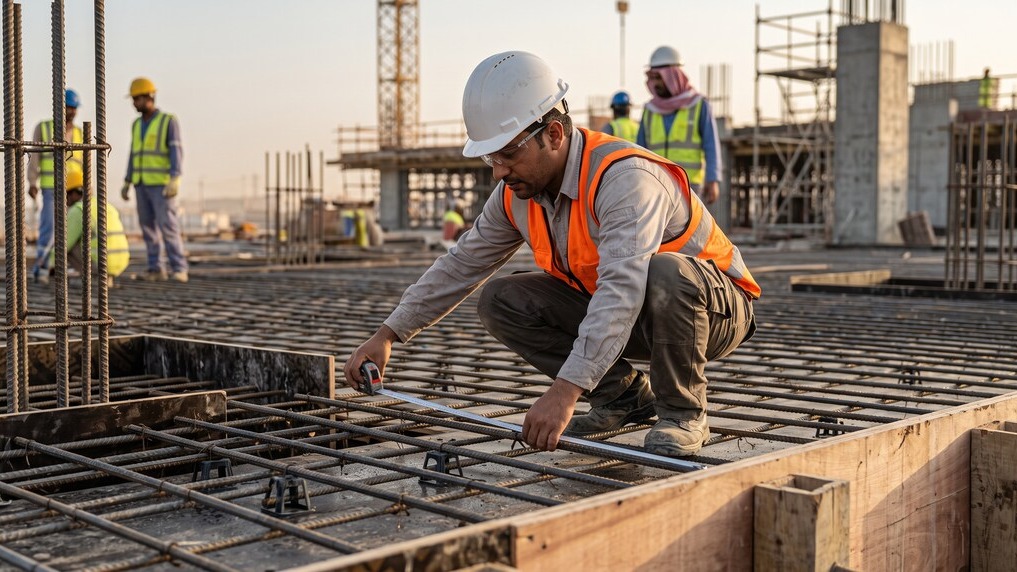
Once concrete has been poured over misplaced reinforcement, or a waterproofing membrane has been covered by a screed, the opportunity to correct a mistake cheaply is gone. That simple fact explains why engineering supervision matters so much. A design can be excellent and fully approved, yet the building that emerges from site can still fall short if no qualified engineer is checking the work as it happens.
In Saudi Arabia, supervision is also a regulatory expectation. The Balady platform lists a contract with a supervising engineering office, alongside the construction contractor, among the requirements for issuing a building permit. But owners who see supervision only as a box to tick miss most of its value.
What engineering supervision actually covers
Engineering supervision is the independent technical oversight of construction on the owner's behalf. Its purpose is to verify that the works comply with the approved drawings, specifications, codes and contract, and to give the owner reliable information for decisions. It has two halves: work done in the office and work done on site.
Office-based activities
Much of what determines quality happens before anything is built. The supervising engineer reviews the design for constructability, checks contractor shop drawings against the approved design, and evaluates material submittals to confirm that proposed products meet the specification. This is where substitutions are scrutinised. A product that appears equivalent on a data sheet may differ in fire rating, structural capacity, dimensions or warranty, and those differences can affect compliance and performance.
Office work also covers checking conformity with project specifications and health and safety requirements, maintaining records, and preparing the documentation that will be needed at handover.
Site-based activities
On site, the core activity is inspection: checking setting out, excavation and foundations, formwork and reinforcement before concrete is placed, masonry and blockwork, waterproofing and insulation, MEP installations before they are concealed, and finishes. Many of these are hold points, stages at which work should not proceed until the supervisor has inspected and approved it.
Site supervision also includes regular progress meetings with the contractor, subcontractors and suppliers; the review and certification of contractor payment applications; evaluation of contractor claims; coordination with the owner on the approval of finishing materials; and the management of preliminary and final handover inspections.
Where supervision pays for itself
Quality that is verified, not assumed
Without inspection, quality depends entirely on the contractor's own controls. Good contractors have them, but even the best benefit from an independent check, and less rigorous contractors need one. Supervisory inspections catch defects while they are still cheap to correct and create a documented record of what was built.
Cost control and fair payment
Payment certification is one of the supervisor's most important financial functions. By checking that the work claimed has actually been completed to the required standard, the supervising engineer protects the owner from paying ahead of progress. Equally, a fair and independent assessment of contractor claims helps resolve disputes on technical merit rather than negotiation alone.
Programme and risk management
Supervisors see problems early: late material approvals, resource shortfalls, coordination issues between trades, or design questions that need answers. Raising them promptly gives the owner time to act. The alternative, discovering a problem when it has already delayed the critical path, is almost always more expensive.
Safety and compliance
Supervision supports compliance with the approved design and the Saudi Building Code, and it reinforces attention to health and safety requirements on site. When authorities or insurers need evidence of how the building was constructed, the supervisor's records are often the most reliable source.
What good supervision looks like
Not all supervision is equal. A few practical indicators help owners judge whether they are getting real value:
- Inspections are planned around construction milestones and hold points, not just calendar visits.
- Inspection results are recorded in writing, with photographs, and non-conformities are tracked until closed.
- Shop drawings and material submittals are reviewed against the design and specification within agreed timeframes.
- Payment recommendations are supported by measured progress, not estimates.
- The owner receives regular, concise reports that highlight risks and decisions needed, not just activities completed.
The owner's role in effective supervision
Supervision works best when the owner sets it up to succeed. That starts with a clear appointment: a defined scope of inspections, agreed reporting frequency, the supervisor's authority to reject non-conforming work, and a process for instructing changes. Ambiguity about who can approve what is one of the most common sources of friction on site.
Owners also need to make decisions promptly. A supervisor can identify a problem, but if approval of a finishing material or a response to a design query waits for weeks, the programme suffers regardless of how good the supervision is. Finally, owners should resist the temptation to bypass the supervisor by agreeing changes directly with the contractor. Doing so weakens the supervisor's position, blurs responsibility and makes it much harder to resolve cost and quality disputes later.
Supervision as part of a continuous service
Supervision is most effective when it connects to what came before and after. A supervisor who understands the design intent, ideally because the same consultancy prepared or reviewed the design, can resolve site questions faster and with less risk of eroding that intent. Strong tender documentation gives the supervisor clear contractual standards to enforce, and effective project management ensures that what the supervisor reports leads to timely decisions.
Aknan's supervision services cover both office and site activities, from design and shop drawing review through daily inspection, payment certification and claims evaluation, to preliminary and final handover.
Conclusion
Engineering supervision converts an approved design into a building that matches it. Done well, it protects quality, keeps payments aligned with progress, surfaces risks early and leaves the owner with a reliable record of what was built. For most projects, the cost of competent supervision is small relative to the cost of the defects, disputes and delays it prevents.